


The Patience Stone and the Spoon in the Tea Glass
Translated from the original Persian post. Images, if present, are from that post or thread.
This story is a little long, but please read it, for yourself, and perhaps for a friend who needs you beside them.
The Patience Stone and the Spoon in the Tea Glass
That summer, Siamak left.
Siamak wasn’t just my friend. He was my classmate, my deskmate, my partner in games of marbles and the ice lollies we bought outside school. His house was at the end of our lane. For as long as I could remember, we had walked to school together in the mornings and come home together in the afternoons.
One evening he came to our door, fighting back tears. “We’re leaving early tomorrow,” he said.
“Where?”
“Dad says very far away. Maybe we won’t come back.”
Then he reached into his pocket and placed his blue marble in my palm. The one nobody else in the neighbourhood had anything like. The one he never staked in a game.
“This is yours,” he said. “So you won’t forget.”
When I woke the next morning, their door was locked.
A few weeks passed, and each day I withdrew a little further into myself. In the evenings, when my uncles and aunts gathered at Agha Bozorg’s house and laughter and the clatter of backgammon rose from beneath the date palm, I would find an excuse. One night I had a headache. Another night I had homework. Another, I was sleepy.
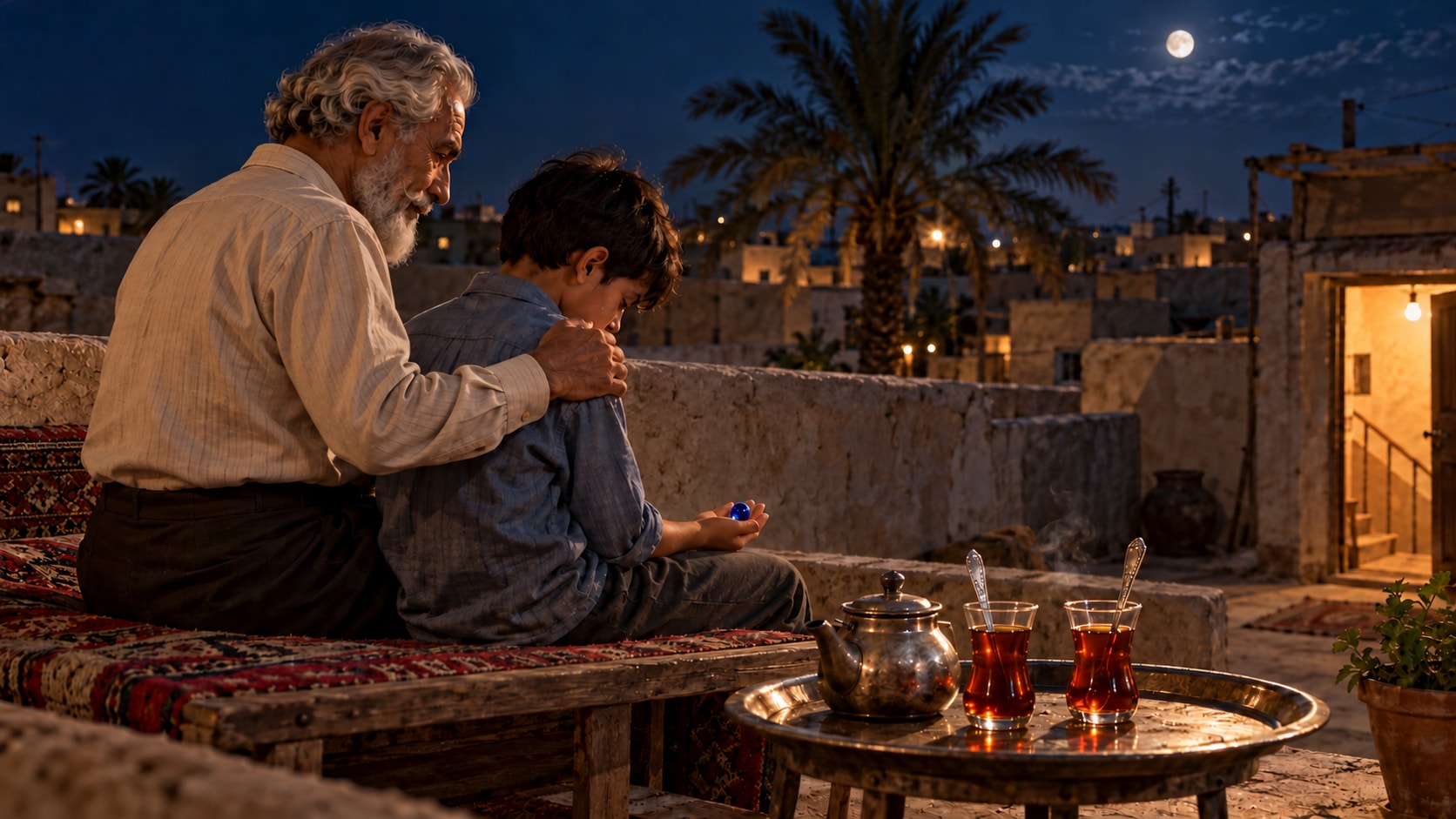
But the truth was that my head didn’t hurt, and I had no homework. I went up to the roof, held Siamak’s marble against the moonlight, and stared at it until my eyes blurred.
I never cried in front of anyone. I didn’t want them to know. My mother had enough sorrow of her own; I didn’t want mine to become another weight on her heart. And whenever my little sister saw me upset, her own lower lip began to tremble. Better to stay away, I told myself. My sadness was mine. Why spoil everyone else’s evening?
Besides, did the eldest boy in the family cry?
One evening, when I had gone up to the roof again, I heard footsteps. It was Agha Bozorg, climbing the stairs with some difficulty, one hand on the railing and the other carrying a tray. On it were a teapot, two narrow-waisted tea glasses, and two teaspoons.
I stood to help him.
“Sit down, sit down,” he said. “I’m not so old that I can’t manage a few stairs.”
He sat beside me at the edge of the roof. First he put a spoon in an empty glass, then slowly poured the hot tea over it. It was something Khanom Bozorg always did, and I had never understood why.
He handed me the glass.
“I’ve lost my boy these past few weeks,” he said. “I look everywhere, but he’s nowhere to be found. There’s just a boy who looks like him, who has headaches and homework and feels sleepy…”
I laughed, but the laugh caught in my throat.
“It’s nothing, Grandpa. I’ll be all right.”
“I know you will. I didn’t ask when you’ll be all right. I came to see how you are now.”
I said nothing. The marble was in my fist. Agha Bozorg glanced at it and said softly,
“You miss Siamak.”
That one sentence was enough. Everything I had held inside for weeks came pouring out. I rested my head on my knees and cried so hard my shoulders shook.
Agha Bozorg didn’t tell me not to cry. He didn’t say men didn’t cry, or that everything would be fine. He just put his hand on my back and sat there. He waited until I grew quiet on my own.
“I’m sorry, Grandpa. I didn’t want anyone to see.”
“Why?”
“Because everyone will get upset. Mum has so much sadness already. I don’t want to pour mine onto everyone else. And boys don’t cry.”
Agha Bozorg took his pipe from his pocket, but didn’t light it. He just turned it in his hand.
“Whoever told you men don’t cry has either never lost anything, or was lying. Grief doesn’t ask permission, son. Your sorrow is the measure of your love. If Siamak hadn’t mattered to you, you wouldn’t be sitting here now. This sadness shows what a friend you had, and what a friend you were.”
Then he asked,
“Have you heard the story of the patience stone?”
“A little. Grandma told it once.”
“They say there was a girl who carried a great deal of sorrow and had nobody to tell. Or perhaps she did, but thought she shouldn’t. She went to the bazaar and bought a patience stone. Every night she sat and told it all her sorrows. The stone was patient. It listened, said nothing, and never told a soul.
“Until one night, in the middle of her confiding in it, the stone cracked and split in two.”
“Why?”
“Because it was a stone. A stone only holds things. Whatever you give it, it stores inside. But it can’t lighten the load, or give anything back, or hold you in its arms. It keeps collecting until one day there’s no room left.”
He paused and looked at me.
“These past few weeks, you’ve become your own patience stone. You’ve poured every sorrow into yourself and shut the lid. From downstairs, I could hear you cracking, son.”
Then he took the glass from my hand, lifted out the spoon, and asked,
“Do you know why Grandma always puts a spoon in the glass before pouring the tea?”
“No.”
“Because if boiling water suddenly pours into a glass all on its own, the glass can’t bear it and cracks. But when there’s a spoon inside, the spoon takes on a share of the heat, and the glass doesn’t break.
“Now listen carefully. The spoon gets warm too. But it doesn’t burn, or get ruined, or lose its shape. It just gets a little warm, then cools down again.
“People are like that too. When sorrow is hot, you shouldn’t be alone in the glass. You have to let someone stay beside you and take on a little of that heat. They’ll only get a little warm. They won’t break.”
“But what if Mum gets upset?”
Agha Bozorg gave a small smile.
“When your uncle Shapour was killed in the war with Iraq, it felt as though I had died with him. My son had been taken from me. I did just what you’ve been doing. For three nights I stayed out in the fields until late so your grandmother wouldn’t see my red eyes. On the fourth night, she came out to the fields too. She didn’t say a word. She just sat beside me. And it was as though a dam had burst.
“Years later, one evening, I said to her, ‘Forgive me, my dear, for putting you through that in those days.’
“‘That was one of the dearest nights of my life,’ she said.
“‘The night I fell apart?’
“‘Yes. Because that night I knew you trusted me enough not to hide even your breaking from me.’
“Do you see, son? We think we’re doing people a kindness by hiding our grief. But sometimes we’re denying them something very beautiful: the chance to be someone we can confide in.
“Do you remember when your sister’s budgie died last year?”
“Yes.”
“Who sat beside her all afternoon, let her cry, and then dug a little grave for it beneath the date palm?”
“I did.”
“Did being there for her hurt you?”
I thought for a moment.
“No. It felt good, somehow. As though I’d been some use to someone.”
“Then why deny other people that good feeling? You’ve always been the spoon in everyone else’s glass. For once, let someone be the spoon in yours.”
Then he braced a hand on his knee and stood.
“Come on. Let’s go downstairs. You don’t have to smile. You don’t have to be all right. Come and sit with us, red eyes and all. That’s all.”
We went downstairs. When my mother saw my eyes, she asked nothing. She just held me, longer than usual. My little sister brought her doll and silently settled right up against me. My uncle pulled the backgammon board towards me.
“Shall we play?”
I lost. But that night, for the first time in weeks, I put Siamak’s blue marble beside my pillow and fell asleep without crying.
That night I understood that sharing sorrow doesn’t make it disappear. But you no longer carry it alone.
My compatriot, my dear one, my friend, a part of my own flesh…
I know these days in Iran are bitter. They’re hard. I know many of us have a Siamak who has gone away: someone we love, a friend, a home, a dream. Perhaps Iran itself.
I don’t want to offer the old cliché: smile, and everything will be fine. No. If you aren’t smiling today, that’s all right. You’re human. If your heart is broken today, you’re human. If you cried, you’re still human.
I ask just one thing. Don’t become your own patience stone. Don’t turn away from me or your friend. Sometimes I break too, just like you. What’s wrong with that? Let’s be the spoon in each other’s glass. Let’s take on a little of each other’s heat. I promise we won’t burn.
Tonight, message someone and say, “I’m not feeling very good.” Or ask someone, “How are you? Really?” Sometimes all someone is waiting for is another person to sit beside them.
We’ve seen the lows. It won’t be long before we see the highs too. And on that day, with these same cracked hearts, we’ll laugh together.
Long live Iran.
Long live the Shah.