


The Winter the Road Closed
Translated from the original Persian post. Images, if present, are from that post or thread.
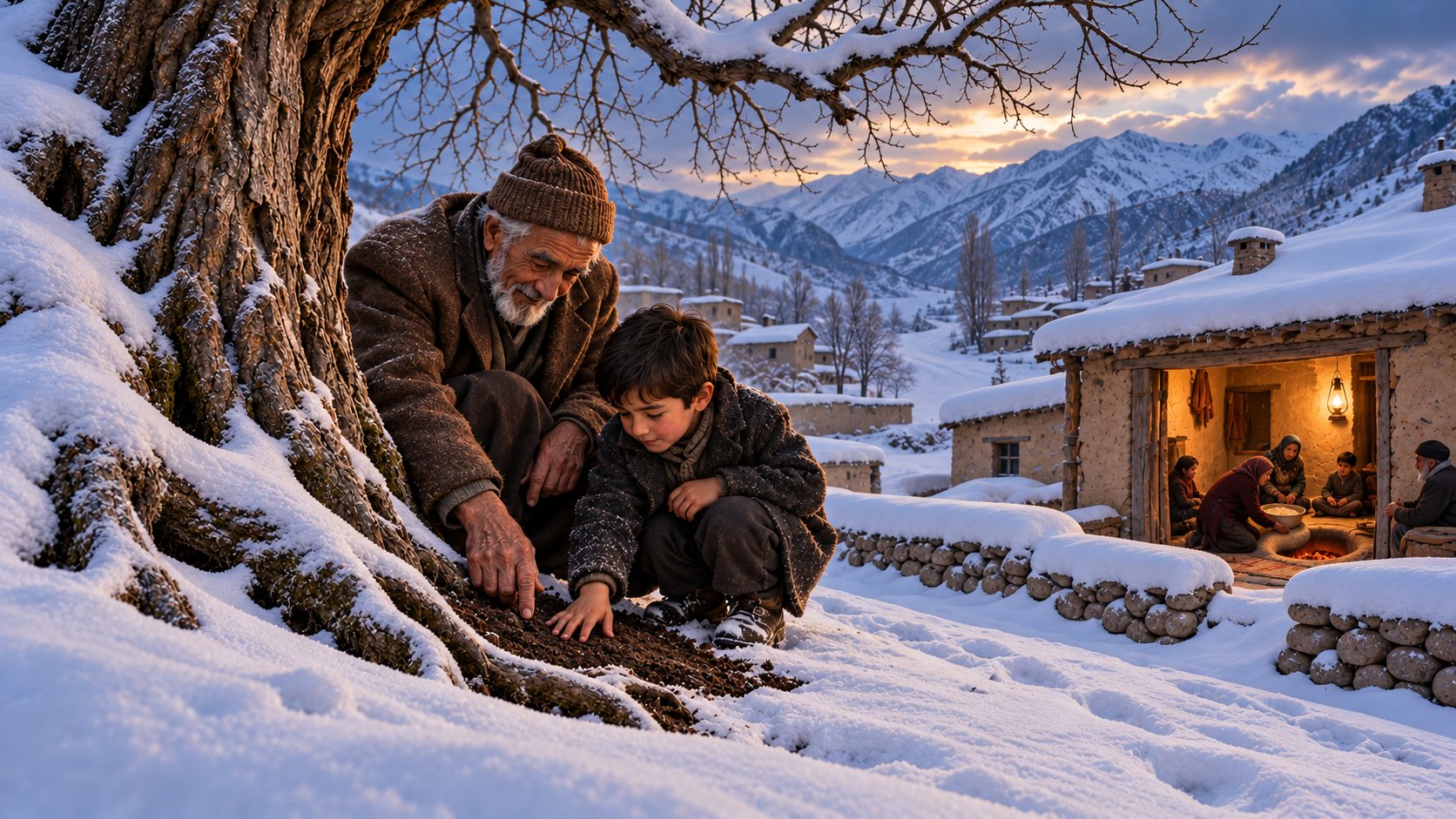
The Winter the Road Closed
I was seven when that winter came, in the village of Naqqash, near Avaj. It snowed as even the village elders could not remember. For three days and three nights it fell. On the fourth day, when the sky cleared, the road to Avaj had disappeared beneath the snow. The power lines had broken, and worse still, Father's radio gave out nothing but static.
For us children, the first day was a holiday. The second, a little less so. By the fifth day the bakery had run out of flour. By the seventh, the oil for the lamps was nearly gone, and the mothers no longer spoke loudly.
I remember the eighth night. We were sitting around the korsi when Uncle Heydar, a quiet man, suddenly said, “No one is coming. The town has forgotten us.”
No one answered. That silence was colder than any snow. I was frightened—not of the snow, but of the look in the grown-ups' eyes.
The next morning I struggled through the snow to Mash Rahim's house. He was the oldest man in the village, and the walnut orchard at its edge belonged to him. He was clearing snow in the yard, reciting poetry under his breath. After greeting him, I said, “Mash Rahim, Uncle Heydar says they've forgotten us.”
He stopped, looked at the lost road and said, “Come with me.”
We went to the far end of the orchard, beside the great walnut tree. He brushed the snow from its base, exposing dark soil. “Touch it,” he said. I did. The earth was warm, even in that cold.
Mash Rahim said, “For three months this tree has had no leaves, no fruit, no shade. From the outside it looks dead. No bird settles on it. No passer-by looks at it. But underground the roots are awake.”
Running his hand over the earth, he said, “You know, son, a tree has one job in winter: to keep its roots alive. That's all. Not to blossom or bear fruit. Just to keep its roots alive. A tree that does that will see spring. But if it says, 'No one sees me, so I'm finished,' then spring won't do it any good when it comes.”
Then he said, “Go tell your Uncle Heydar that Mash Rahim's oven is lit. Anyone with a handful of flour can bring it; tonight we'll all have bread.”
That night several families gathered around his oven. There wasn't much bread, but the silence broke. Grandmother told the children a story. Uncle Heydar laughed for the first time in eight days. The next day the men took shovels to the road—not because they could clear it all the way to Avaj; they couldn't. They cleared just a hundred metres. But when they came home that night, they were no longer the men of the eighth night.
The road opened twenty-two days later, not only with the grown-ups' shovels, but with the help of the sun.
When the first car arrived from Avaj, the driver said the town had been talking about our village the whole time. They knew! They were worried. They just couldn't reach us.
Years later I realised Mash Rahim had taught me two things that day, not one.
First, being forgotten is a feeling, not necessarily a fact. The world had not forgotten us; it simply couldn't reach us. No tree in history has dried up because no passer-by looked at it.
Second, in winter no one asks you to bring spring. They ask one thing: keep the roots alive. A lit oven, a handful of flour, a story for the children, a hundred metres of road that leads nowhere—but keeps people alive.
Today Iran is in a winter with its road closed. The wires have been cut, the radio crackles, the bakery has no flour, and every night someone in a house says, “They've forgotten us.” I know that silence. It's colder than any snow.
But the roots are alive. Touch them; they're warm. Every teacher who still teaches, every mother who still tells stories, every neighbour who knocks and asks, “Do you need anything?”, everyone who writes the name of someone we have lost in a notebook so it won't be forgotten—each is a root. You can't see it from outside. But the tree lives because of them.
The road will open. It always has. The question isn't when. It's what we will be when it does: a tree with warm roots, or dry wood waiting for a passer-by to notice.
My compatriot, my dear one, my friend, a part of my own heart: tonight take a handful of flour and knock on your neighbour's door. Spring begins there.
For thousands of years, our Iran has rested on the roots and culture of the people who have kept this soil alive, who have given meaning to being Iranian. So be the warmth of hope in this land.
Long live Iran.
#JavidShah